
Revisiting Pride and Prejudice
“You have bewitched me body and soul, and I love, I love, I love you. And wish from this day forth never to be parted from you.”

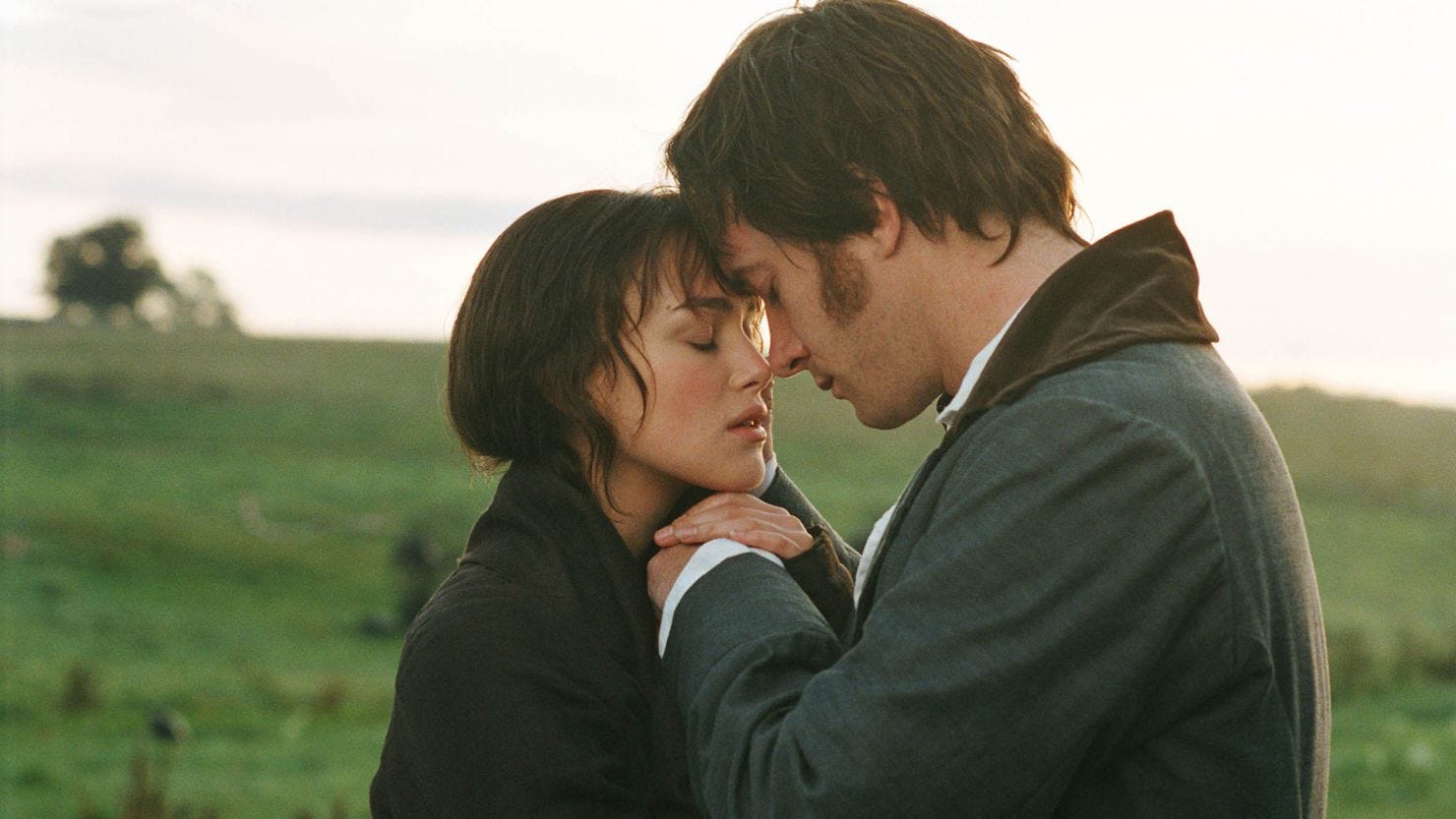
A mark of a good novel is in its ability to remain good upon rereading. Pride and Prejudice remains Jane Austen’s most infamous work. And this is with good reason, I can not imagine a more perfect novel. It needlessly deserves its place as the quintessential Victorian novel. Maybe this praise sounds haughty and gallant, and is too much to give a love story, a novel that follows protagonist Elizabeth Bennett as she navigates the trivialities of high Victorian society and attempts to find a husband. Many of these customs seem backwards to modern audiences, and the love story between Elizabeth and Mr. Darcy is successful on questionable merits. Darcy, we are told, is the owner of a large estate, an extremely rich man, who is hardly subtle in his knowledge of his own fortune and intellect. Elizabeth is a unique heroine. She fancies herself above the materialistic shallow society represented by her mother and younger sisters, but is just as much a product of it. This novel is no scrupulous criticism of society or marriage customs, but in painting them so astutely, it manages to capture audiences centuries after its publication. Somehow it is more effective criticism, of human impartiality, of pride and prejudice because it exists in this fictional landscape but also is recognizable. This has to do with Jane Austen’s unique ability to observe, know, and capture people.
Primarily, Pride and Prejudice is a love story, and this is no trivial matter. I am hesitant to say I dislike this novel after praising it so much. To enjoy this novel is to recognize that Pride and Prejudice is not meant to do everything, just as any one novel, or one essay, is not meant to do everything. In tandem with Pride and Prejudice I am currently reading Game of Thrones. The incompatibility of these two in tandem can only be a consequence of love, I am reading both out of love. Though, they could not have a more different presentation and conception of love. Game of Thrones is entirely its own universe: the backwards and preverse loves, misplaced loves, grotesque loves, and sexual violence, place it in a catagory that seems untouchable by the likes of Pride and Predjuce. The comparison is more than apples and oranges, it is perhaps equivalent to something like apples and buildings. Thus, it is merely by chance that I strike to make the comparison. Austen’s depiction of love is within the constraints of Victorian society, meaning that even the slightest elude to intimacy is highly contemptuous. It is also needless to suggest that the feelings between her and Mr. Darcy can be anything but love, and the truest love. This is because anything truth positioned so outwardly in a novel must be taken as true. I can not draw a particular conclusion thus about love, aside from the personal position that I am always shocked by the capacity of love to be unpredictable and elusive.
I was asked recently if I could love Mr. Darcy. Apparently, there is a common problem of women falling in love with Mr. Darcy after reading this novel. I can imagine the impetus of this problem. I did not personally feel any particular regard for Mr. Darcy, but there are many things that make him such a compelling character. Firstly his earnestness, maybe that he loves Elizabeth so much so without having or needing any justification. In fact his love makes hardly any sense given her connections and finances, a point which he makes known when he first asks her to marry him. But, what I find most compelling about their love, is that he first falls for her eyes. Maybe this has to do with the fact that I know the feeling very well, the unique feeling of falling for someone’s eyes. And maybe it is only a feeling ascribed in retrospect, now that such a love is actualized it can only be attributed to this particular feature, the eyes. Only the eyes can hold the burden of such a feeling. Occasionally a pair of eyes just strikes you-- I can attest that it has happened to me not once, but many times, resulting in great friendships.
These might seem all frivolous matters, as the problems posed in Pride and Prejudice must seem as well. But this felt important to write as rereading this novel reminded me of something important I had forgotten or lost somewhere. It is no particular thing, but it is the thing that made it possible to watch the same movie or listen to the same song or come home to the same people, and be not happy, but overjoyed at knowing the movie and song were your favorite, and the people, your family. And this thing does not simply color what may be mundane, it is color, it is words, it is air, and all the other things that remind me why it is I write.